Pages

10 October 2009

IN PRAISE OF CHEDDAR


I love cheese. Hard cheese, runny cheese, white cheese, yellow cheese, blue cheese, old cheese, young cheese--you name it. You might remember that I live in a cheese - producing region. You’d think that this would make me happy. Content. Not wanting to ask for another thing.


So you can imagine how thrilled I was when my friend Danielle brought me this lovely:

It’s farmhouse cheddar, from England by way of the South of France. Danielle and her husband have a house in the Dordogne, near some gorgeous markets. In one of those, Danielle found this cheddar. Oh, my. There’s 500 g of this white gold--just over a pound. It’s crumbly and lovely and nose-tickly.


After I nibbled it a couple of times and gave part of it to my friend Francoise (who loves cheddar as much as I do), I have about 250 g left. What should I do with it? I’d love to hear your ideas.


06 October 2009

FANCY PANTS POTATOES


Who says you can't play with your food?

I was roasting a chicken recently, and I wanted to roast some potatoes along with it. Normally I just cut them in pieces and parboil them about 5 minutes then just throw them in with the chicken. They’re always delicious!


The other day I thought I’d do something a little different. Something a little fancy.


I cut two large potatoes in slices and then cut out star shapes. I boiled them in salted water, wiped them with olive oil and put them in a roasting pan in the oven with the chicken for the last 30 minutes or so of cooking. The last time I basted the chicken I also basted the potato stars. Not too much, I didn’t want them swimming in the juice, but enough to moisten them and make them sizzle a little.


For a change, I timed it just right: the potatoes were done when the chicken was done. I sprinkled them with a little finishing salt and VOILA! They were wonderful--crisp on the outside and soft on the inside. The basting didn’t keep them from being crispy, it just added some of the chicken flavor to the potatoes.


YESSSSSS! I’d serve these to company!


Fancy Pants Potatoes


4-6 large potatoes

3-4 Tablespoons salt

approx. 2 Tablespoons Olive oil

Finishing salt

Cookie cutters in whatever shapes you like


Preheat oven to 200 C / 400 F. Wash the potatoes and cut them in slices about 1 cm / 1/2 in thick. Cut out shapes with the cookie cutters. Bring a large pot of water to boil and add the salt. Yes, all of it. Boil the potato pieces in the salted water for approximately 5 - 6 minutes. Drain and rub with the olive oil. Put in a single layer in a large, shallow oven pan, and bake for 30 minutes. Check them from time to time and shake them around a little. Turn them if necessary to brown all sides. Make sure that they’re in a single layer-don’t pile them on top of one another or they won’t brown properly. Sprinkle with finishing salt to serve.


Serves 4 if they like it and 10 if they don’t.


P.S. I put the potato pieces left over from cutting out the stars in the pan with the chicken. They were good too, just not very fancy. They could also be cooked separately and mashed.


Variations:


  • Sprinkle potatoes with crushed rosemary before roasting.
  • Use flavored olive oil: garlic, hot pepper, herb
  • You can also do these on the stove top in a non-stick pan. Boil them about 10 minutes in salted water (to cook them through) and drain them. Heat some olive oil in a non-stick skillet and put the potatoes in the pan over medium high heat. Let them brown on one side and then turn them to brown the other side. This should take about 15 minutes total. Sprinkle with finishing salt and serve. I’d probably add some freshly chopped rosemary to the olive oil before I added the potatoes. (Of course, the sides won’t be browned with this method)


04 October 2009

RISOTTO ALLA MILANESE ...and a little bit about saffron


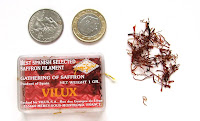
Saffron threads are the dried stigmas of a crocus flower, "Crocus Sativus Linneaus". Each flower has three stigmas, which are picked carefully by hand. Around 250,000 stigmas are needed to produce a pound of Saffron. THAT’S why it’s so expensive! Luckily for us, a little tiny bit goes a long way. Saffron is the distinctive flavoring and coloring agent in Spanish Paella. It’s also the main flavor/color in the Italian specialty Risotto a la Milanese (recipe below).

Saffron is produced in warm climates. In Europe, most of it comes from Spain or Italy or Greece or Iran. I usually buy it when I’m in Spain or Italy, and it’s (a little bit) cheaper that way.


You can buy saffron in two forms: threads or powder.


If you buy threads, be sure that they’re a dark red/orange color, and that they’re dry and brittle. If there are some lighter orange or yellow or beige threads in there, it’s a lower quality and won’t have the strength of good saffron--you’ll need more for the same effect, and in the end it’s more expensive. When you use the threads, they should be soaked for at least 10-15 minutes in a little warm water to release the flavors (but the longer you soak them the stronger the flavor). The resulting ‘tea’ can be mixed into whatever you’re making, along with the threads. I like to see the little threads in finished dishes. You can also steep the threads in warm milk or broth or whatever liquid you’re using if you don’t want the water to dilute the dish. Or you can steep them in room temperature wine or lemon juice.


If you buy powder, it should have the same dark red/orange color. It’s important to be sure that you buy from a reputable source, because it’s not all THAT hard to adulterate the powder. I use powder when I don’t want to have the little red threads in the finished dish, or when I want stronger color overall. You don’t have to soak the powder, you just add it to the dish near the end of cooking.


Whatever form you use it in, it should always be added near the end of cooking. Here’s one of my favorite ways to use it:


Risotto alla Milanese


1/2 liter / 2 cups chicken or vegetable stock

6 tablespoons olive oil

1 onion or 2-3 shallots

7 oz / 200 g Arborio or Carnaroli rice

6 ‘portions’ saffron

75 / 1/4 cup ml white wine

100 / 4 oz g fresh parmesan, freshly grated


1. Finely chop the onion or shallots. Put the stock on to heat. It should be simmering.


2. In a wide, shallow pan, heat the olive oil and add the onion. Cook gently, till it starts to brown. Add the rice, and stir till the rice becomes translucent. It should look like this:


3. Add the wine, and stir till it’s gone. Add 1-2 ladles full of hot stock, and stir. Cook on medium low heat till the stock is absorbed by the rice, and then add some more. Stir the rice often to make sure it doesn’t stick. Continue doing this till the rice is done, about 25 minutes (if you run out of stock, you can use hot water).


4. Check the rice starting at about 20 minutes. It’s done when it has a creamy sauce all around it and there is no longer a hard center. You don’t want it soft, but it shouldn’t be crunchy.


5. When you add the last ladles full of stock, add the saffron and stir it in well. When the rice is done, you want it to be a little runny, because then you’ll add the grated parmesan. Stir it well, add salt and pepper and serve.


Serves 4 if they like it and 10 if they don’t.


Notes:

  • You can use any rice that’s meant for risotto--this is short grained rice. Don’t use rice that’s meant to be steamed, because it won’t have the starchy exterior that it needs to make the sauce.
  • If you don’t have stock, you can use hot water. If you want to make this vegetarian, use vegetable stock.

  • There are two ways to serve risotto in Italy: creamy and not too liquid, or very runny. The runny style is called “alla onda”, and is the way Jamie Oliver says it should always be served. Pooh. I prefer it creamy and less runny.

03 October 2009

LOVE NOTES

When we first met, Dan and I lived 1500 / 2500 km miles apart. When we saw each other, it was a special occasion. We didn't have much daily ordinary stuff together. We did that for eight months, then we got married and I moved to Washington. But during that eight months, I got something in the post every day from him. A letter, a post card, a clipping, a funny note, something every day. For us, it was one way to bring the daily ordinary stuff into our separated lives. We’ve been married for almost 20 years now, and we’ve had plenty of daily ordinary stuff. Somehow, though, the special spark has never left, and the love notes continue. Not in the post, but in small, special things. Here are some examples:


Every morning he brings me a cup of espresso in bed. He gets up and goes to the kitchen and makes it with an espresso machine we chose together. He brings me a steaming cup to help me wake up. It’s wonderful coffee: strong, fortifying, life-giving. Like love. It’s practically the only coffee I drink anymore. Nothing else can match it!


Dan is in Brussels today, all day. He took an early train and so we got up at 5:30. After my morning coffee, I went to my bathtub to soak while he had his breakfast and left for the train. When I came into the kitchen it was still dark in the house. Gleaming under the lights I found another love note:


My breakfast place set for me. Nestled inside the napkin ring were my vitamins.


Tell me about a love note you've received lately.

28 September 2009

SIDE TRIPS: To Market, To Market!


There are open-air markets every day in a town or village around here. My favorite one is on Sunday mornings in the nearby town of Aubel. It’s smaller than the raucous, lively market in my town, but the quality of the food is extremely high. Most of the food sellers are selling what they’ve produced themselves, rather than re-selling food that they’ve bought. The food is local, fresh, and I love dealing directly with the producers.Not all of the vendors here are producers as well, and some of the producers mix ‘imported’ food with their own stuff. But the atmosphere here is always happy, the food is good, and the 15-minute drive is through some gorgeous countryside. I love to go.


Yesterday morning I took my camera and brought back some photos, so if you’re too far away to come to the market with me, you can come along on a virtual tour!


This man sells sausages that he’s made. There are several different kinds, some spicier than others. Some have herbs and others are made with different kinds of meat in them. He also sells a prosciutto-like dried ham made from wild boar, a specialty of the Ardennes. Have a taste!


Next comes cheese. Because we're a cheese producing region, there are a lot of cheese vendors at this market. I had to get there very early this morning to get this photo--normally this counter is three or four people deep. He has cheese from Belgium, France, Italy and Germany. But the photo he wanted me to take was the one on the right, with the local cheese, Herve. Aubel is situated on the plateau of Herve, where a soft, ‘strong’ (read stinky) cheese is produced. I’ve seen this cheese for sale in markets in Provence, where it’s much appreciated for its strong flavor. These people not only produce the cheese, they also have free-range eggs and cream cheese for sale.

And of course, fruit and veggies!

The big vendors are often resellers, ‘though some of their products may be local. “du Pays” means it’s from the Region. “Belgique” means it’s from Belgium. The grenaille potatoes you see above are firm, for boiling. Other strains are better for mashed potatoes, still others for the famous Belgian fries.


This woman is selling a traditional specialty of the region, cuberdons. These little cones have a soft, jellied center. The range of flavors is amazing, though the traditional one is raspberry. YUM! The colors glowing in the sun were irresistable for me. I bought an assortment.

I love this guy. He sells eggs, butter and whatever orchard fruit is in season from the back of his car. No fuss, no fancy booth--just opens up his car and sells it to you. His butter tastes of what his cows have been eating--flowers, onions, garlic sometimes. It’s wonderful to cook with.

Along with the buzz of crowds shopping and the merchants hawking their wares we have music. And smells. The smell of fresh bread, of spices, of vegetables and fruit. Someday they’ll invent a camera that can capture sounds and smells--


This is where I often buy my goat cheese. She also has homemade jams and honey from her bees.


More cheese. This man has cream cheese from both goats and cows. He also has hard gouda-like cheeses with garlic, herbs, spices in them. In the spring there’s one with nettles! If I want one he doesn’t have, he can tell me when it will be ready. His cheeses are local, they’re organic, and I love buying them from the person who milked the cow.


It’s mushroom season! The mushroom lovers are out combing the forest, finding c
hantarelles, girolles, cepes and trompettes de mort. I have to confess that I don’t have any confidence in my own ability to identify mushrooms--I don’t hunt them. I buy them. This year is not a good one for mushrooms in Belgium, because we’ve had a dry and glorious summer, without our normal rains. So many of the mushrooms available here are from France.

We’re not far from the North sea, so of course there’s a fishmonger. What I like about his stuff is that it doesn’t smell like fish. It smells like the sea. It’s fresh and always good. It was hard to get photos because it’s all behind glass and the sun was shining.


I grew up in the Southeastern part of the US: Ham. Barbecue. Greens. Okra. One of the things that I miss here is ham. You can buy it, but it’s already cut and it’s often bland and tasteless. You CAN’T buy a ham to cook at home, though. I don’t know why. I think maybe because the ovens are smaller and a whole ham wouldn’t fit? Or maybe because it’s just not the tradition here. In any case, I have finally found a source of wonderful ham. This young lady and her grandmother sell ham and fresh meat at the market. This ham is reallyreally tasty. It’s sliced by hand, and you can specify which piece you want. The grandmother told me that it takes three months to make a ham, and her family has been hamming since 1904. There aren’t many farmers who still make their own ham. Most of it’s commercial. I will patronize this family as long as they are there. Good ham is something one shouldn’t have to do without!


We are currently having a dispute between the dairy farmers and the supermarkets. The farmers are paid only a fraction of what it costs them to produce the milk. As we used to say when I was a consultant, “You can’t lose a little on each one and make it up in volume”. So a group of young dairy farmers is selling milk directly to the public in the market.


Can you see why I like this market?

24 September 2009

TUSCAN AUTUMN SOUP

A couple of years ago, I was fortunate to be able to participate in a professional cooking course in Siena. We spent all morning, all afternoon, and into the night cooking. We prepared traditional Tuscan food and learned how to select, prepare, and cook the freshest ingredients. I also learned at a gut level (maybe I should say at a FEET level) how physically demanding restaurant work is. I went back to our apartment

every night exhausted, with my feet hurting and my head full of wonderful ideas. Some nights I couldn’t sleep because my hands ached from having rolled out pici (a round,eggless, spaghetti-like pasta) for 30 people by hand.


From this course I took away many things. Fond memories of meals and friends made, ideas shared in Italian and English and French. That wonderful moment when service was finished and we all finally sat down and ate something--sometimes the ribs that we had used as a roasting rack for the pork, or the brown, crusty ends of the turkey roll, or maybe just a bowl of rice with pepper and fragrant, grassy Tuscan olive oil. It was then that we enjoyed the bonds forged by working hard and performing a seemingly impossible task together.


I took away from the course a better understanding of ingredients and a sense of the Italian way of putting them together. I also took away from the course a notebook stuffed with recipes and ideas (of course!). In it are some classics, some cheffy new Tuscan dishes, and this soup. This is the soup I make when the weather first turns cold and I want something hearty. This is the soup I make when I am having company and I don’t have the time or energy to fuss a lot. This is the soup I make when I want to remember the taste of Tuscany in the autumn.


This soup is hearty, and it's a meal in itself served with salad and some crusty bread. It's also vegetarian, even vegan if you replace the butter with olive oil.


I have seen a lot of recipes for chickpea soup, but I’ve never seen this one except in my course. The first time I tasted it I almost cried, it was so good: complex, layered flavors, golden color, crunch from the croutons. Try this. You owe it to yourself.


Tuscan Autumn Soup (Passata de ceci)


Ingredients

7-8 cloves garlic

4 shallots or 1 large, mild onion

5 cups soaked, cooked chickpeas

12 - 15 sage leaves, the fresher the better

1/4 cup olive oil

1/2 stick / 50 g butter

12-15 bay leaves, the fresher the better

Leaves from a bulb of fennel

4 oz/ 100 gr tomato paste or plain tomato sauce

1 cup brandy or white wine

5-6 doses of saffron

3-4 small dried hot peppers


To serve

3-4 slices stale bread

a walnut-sized piece of butter


In a deep pot, simmer the chickpeas and their cooking liquid with the sage leaves.


If your saffron is in threads, add it to a little hot water and let it steep. If it’s powder, you can just add it directly to the soup at the end of the cooking (below)


In a frying pan, melt the butter with the olive oil and add the chopped garlic and onions. Crumble the dried peppers over it, and add the bay leaves. Saute over medium low heat until the bay leaves are soft and fragrant and the onion and garlic are translucent. Do this relatively slowly, as you’re infusing the oil and butter with the flavors.


Add the tomato paste/sauce and the brandy/white wine. Cook over medium heat till it’s almost dry. Remove the bay leaves and add the mixture from the frying pan to the chickpeas.


Liquefy with an immersion blender or by transferring to a blender. Add water if necessary to get the consistency you want. Put the bay leaves back in and add the saffron and the fennel leaves. Turn the heat off and let it sit for at least an hour. Really. This makes a huge difference. Don’t forget to remove the bay leaves again before serving.


Before serving, cut the stale bread into cubes, and melt the butter in a small pan. Add the bread cubes, toss, and let brown slowly over medium-high heat. Toss from time to time to brown them evenly on all sides.


Ladle the soup into bowls, add the hot croutons (I love the sizzle), and enjoy!


Serves 4 if they like it and 10 if they don’t.


Notes:

1. You can substitute four cans of chickpeas. I don’t have to tell you that it’s better with the dried, soaked beans, but if you’re pressed for time, go ahead and use the canned. It’ll still be heavenly.


2. I never understood the point of bay leaves before this recipe. But now they’re among my favorite herbs. The smell of them as they sautee is out of this world.


3. In Siena we didn’t use fennel leaves, we used finocchio fiori, which are the dried petals of wild fennel flowers. Unless you’re in Tuscany, you’re probably not going to find this. Believe me, I’ve tried. You can substitute fennel leaves, if you can find a bulb with leaves on it. I just keep finocchio fiori in the freezer, and stock up when we’re in Italy.


4. You can skip the fennel flowers and the saffron if you can’t get them, but you’ll miss a subtle layer of flavor, as well as some of the golden color.


5. While this might seem like a fussy recipe, remember, it’s ITALIAN. Everything is approximate. Feel free to play with it!


6. This recipe is gluten free if you leave out the croutons.


23 September 2009

Free to a Good Home

To whom it may concern,


I’m writing to see if you can provide a home for my Mandoline. This nifty kitchen tool saves hours and hours of work. With it, you can slice things very fine very quickly. You just slide the to-be-sliced item back and forth over the veryvery sharp blade, and voila! You have perfect, uniform slices.


You can slice carrots, zucchini/courgettes, cucumbers, anything you can hold in your hand. You can also slice fingers, if you’re stupid. But wait! This Mandoline comes with a safety device, specifically designed to protect fingertips from the veryvery sharp slicing blade. This device cleverly grips the item to be sliced, keeping fingers behind a shield, where they belong. Only a very stupid person would use the Mandoline without the device, because the blade is veryvery sharp, and is designed to slice anything that passes over it--carrots, tomatoes, beets, fingertips, it doesn’t care. But WE do, so we have the clever safety device, which only a very stupid person would refuse to use.


Because sliced off fingertips bleed a LOT, and we don’t want to have blood all over our items-to-be-sliced, do we? And it’s hard to type with a bandaged finger--it wants to hit two keyts at opnce. And with a bandaged finger you have to wear a nasty-smelling latex glove in the kitchen to keep it dry and your hand will smell like latex all the time. No, no, we wouldn’t want that. That’s why we have the safety device. Which comes with the Mandoline. Free.


This Mandoline needs a good home. Don’t let the fact that it’s tasted human blood scare you. It really CAN be trusted...


Sincerely,


Stupid


Photo courtesy of Sur La Table